I recently visited the Houston Museum of Natural Science, and of all the remarkable things housed there, I must confess that my favorites were the dinosaurs.
I found a bench across from a pair of Tyrannosaurus rex skeletons and the enormous flying reptile Quetzalcoatlus. For a while, I simply sat and stared. It is one thing to see such creatures reduced to measurements in a book. It is another to stand beneath their bones and understand, on an instinctive level, their size and ferocity.
My mind wandered—as it often does—to the medieval world.
What would a warrior armed with a spear, sword, shield, or bow have done against something like that? A lone man would have had almost no chance. Even a company of seasoned fighters would have faced an animal beyond anything in their experience. Looking at those skeletons, it was easy to understand why mankind has told stories about dragons for as long as we have told stories at all.
Dinosaurs are the closest things to dragons the natural world has ever produced. Some flew. Some were armored. Some possessed jaws capable of crushing bone. Yet they are separated from human beings by roughly 66 million years—or so the physical evidence tells us.
So why do dragons appear in traditions from Scandinavia to the Mediterranean and far beyond? Why were serpentine monsters so important to the Norse, who lived in a northern landscape with relatively few snakes? Why did warriors carve dragon heads onto ships? And when we read about Jörmungandr, are we encountering an authentically Norse creature—or a pagan myth reshaped by Christian hands?
The answer begins with a problem of language: the Viking dragon was not necessarily the creature we now call a dragon.
The Norse Dragon Was Usually a Serpent
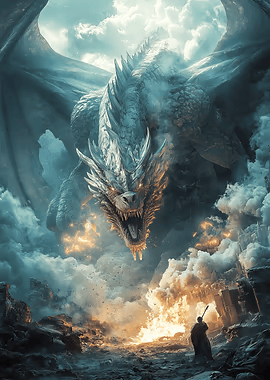
Modern fantasy has taught us to sort dragons into neat categories. A “proper” Western dragon has four legs, two wings, scales, horns, claws, and an unfortunate habit of setting villages on fire. A two-legged winged creature is a wyvern. A wingless, elongated beast is a lindworm. A sea serpent belongs in another category altogether.
The Norse were not working from our modern bestiary.
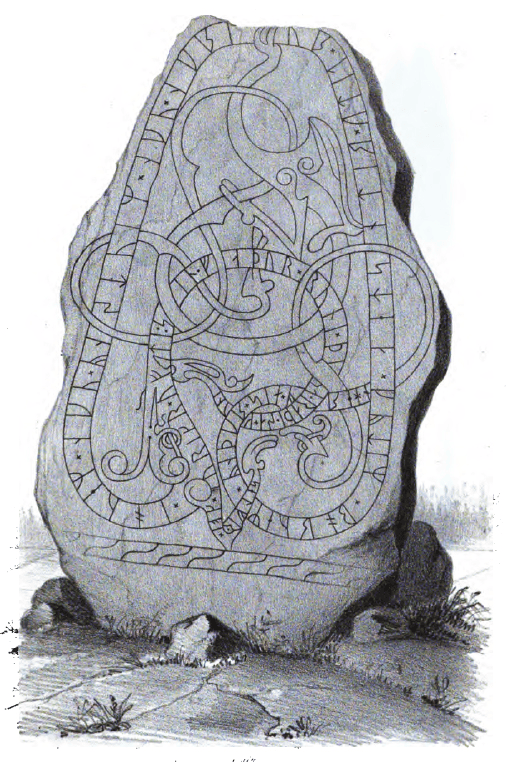
Old Norse writers used several overlapping words for serpentine creatures. Ormr could mean a worm, snake, serpent, or dragon. It is related to the Old English wyrm, the source of the archaic English word for a dragon. Dreki was more specifically a dragon or great serpent and could also describe a dragon ship. Other words, including naðr, could mean a snake or adder.
The borders between these creatures were fluid. A monster might be called an ormr in one passage and a dreki in another. It might crawl rather than fly, spit venom rather than flame, or possess an anatomy the storyteller never clearly explained. The Old Norse dictionary tradition preserves this overlap, while recent scholarship likewise identifies ormr and dreki as the principal—but not interchangeable—terms used for dragons and serpentine monsters.
This matters because the word dragon can mislead a modern reader. When we hear that Sigurðr killed a dragon or that Thor fought the World Serpent, our imagination may add wings, limbs, and fire that the earliest Norse version never supplied.
The archetypal northern dragon was often something older and more elemental: a colossal snake, a living coil beneath the earth, a poisonous creature in the sea, or a hoard-guardian stretched across the boundary between the human and supernatural worlds.
A Land “Without Snakes”?
Scandinavia has fewer snakes than warmer parts of Europe, but it is not devoid of them. Sweden and Norway are home to three native species: the grass snake, the smooth snake, and the common European adder. The adder is venomous and ranges remarkably far north. Sweden’s Skansen notes that it is the only one of the country’s three snakes considered dangerous to people, though serious encounters are uncommon.
That relative scarcity may actually have strengthened the snake’s mythic power.
To a farming or seafaring society, a creature that moved without legs, disappeared into holes, shed its skin, emerged from apparent death after winter, and carried venom in its mouth already possessed supernatural qualities. A snake belonged simultaneously to the surface and the hidden world beneath it. It could represent renewal, concealed knowledge, death, the grave, or the dangerous forces encircling ordered human life.
The Norse also traveled widely. Viking-Age Scandinavians sailed through the British Isles, Francia, Iberia, the Mediterranean, the Baltic, and the river systems leading toward Byzantium and the Islamic world. They encountered foreign animals, foreign art, Roman military symbols, Christian serpent imagery, and stories whose roots reached deep into Indo-European and Near Eastern tradition. Northern dragon lore did not have to develop in isolation.
There is also a simpler answer: myth enlarges what nature provides. A culture does not need to live among thousand-foot serpents to imagine one. It needs only a snake, an ocean whose end cannot be seen, and generations of storytellers willing to connect the two.
Jörmungandr: Dragon, Serpent, or Christian Invention?
The spelling is Jörmungandr, although the anglicized Jormungandr is perfectly serviceable when the special character is unavailable. He is also called Miðgarðsormr—the Serpent of Midgard.
Jörmungandr is one of the three monstrous children of Loki and the giantess Angrboða. Cast into the sea by Odin, he grows until his body encircles Midgard and his jaws close around his own tail. At Ragnarök, he rises from the ocean and confronts Thor. The god kills him, walks nine paces, and then falls from the serpent’s poison.
Is this merely a pagan serpent forced into a Christian story of good defeating evil?
Not quite.
Snorri Sturluson, who wrote the Prose Edda in thirteenth-century Christian Iceland, unquestionably viewed the old religion from the outside. His orderly cosmology, his explanations of the gods, and possibly some of his moral framing reflect the intellectual world in which he lived. No responsible reading of Snorri should treat him as a tape recorder preserving the Viking Age word for word.
But Jörmungandr cannot be dismissed as Snorri’s Christian creation. The story of Thor fishing for the great serpent appears in Ragnarsdrápa, attributed to the ninth-century poet Bragi Boddason. It also appears in Húsdrápa, Hymiskviða, and several Viking-Age or early medieval carvings. The Skaldic Poetry Project preserves the early poetic evidence, while stones at Altuna, Hørdum, Ardre, and Gosforth have been interpreted as depictions of Thor’s fishing expedition.
The myth therefore existed before Snorri and before Scandinavia’s full conversion to Christianity.
The more likely modern distortion comes from translation and expectation. Jörmungandr is not necessarily a “dragon” in the later European sense. He is an ormr: an immeasurably vast, venom-bearing serpent. Even his name is difficult to compress into English. The first element suggests something immense, mighty, or world-encompassing; the second, gandr, can indicate a supernatural being or elongated entity. “World Serpent” captures his role better than it captures every shade of the name.
He is also more than a villain. While Jörmungandr is Thor’s enemy, his body forms part of the world’s structure. So long as he holds his tail, the boundary remains intact. When he releases it, cosmic order fails. He is destruction, but he is also containment—the terror lying just beyond the fence that helps define what the fence protects.
That is a profoundly Norse idea.
Fáfnir, Níðhöggr, and the Northern Dragon
Jörmungandr is not the only great serpent in Norse tradition.
Fáfnir begins not as a beast but as a person—or, depending upon the version, a dwarf-like being—consumed by greed after taking possession of cursed gold. He transforms into an ormr and lies upon his hoard. Sigurðr does not defeat him in a chivalric charge. He digs a pit, waits beneath the creature’s path, and drives his sword upward into its vulnerable underside. After tasting Fáfnir’s blood, Sigurðr gains the ability to understand birds.
Here the dragon is greed made flesh. Fáfnir does not merely guard treasure; treasure has deformed him into a monster.
Níðhöggr inhabits another part of the Norse imagination. He gnaws at a root of Yggdrasill and is associated with corpses and the dishonored dead. In Völuspá, he appears as a dark, winged or flying creature bearing bodies. Níðhöggr is not simply a large animal waiting to be slain. He is corruption at the foundation of the cosmos—the thing forever chewing beneath the structure of existence.
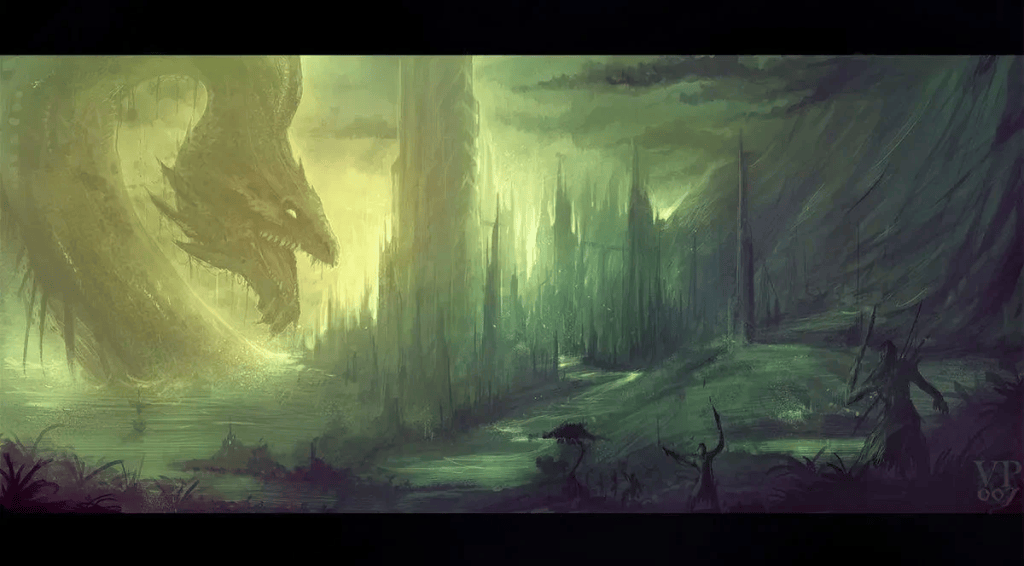
Together, these beings reveal the range of the Norse dragon:
- Jörmungandr is the boundary of the human world and the return of cosmic chaos.
- Fáfnir is greed, cursed wealth, and self-transformation into monstrosity.
- Níðhöggr is decay, dishonor, and destruction beneath the roots of creation.
The common thread is not fire or wings. It is the dragon’s relationship to boundaries: sea and land, life and death, wealth and ruin, order and chaos, the known world and whatever waits beneath it.
Why Put a Dragon on the Prow of a Ship?
Few images are more closely associated with the Vikings than a longship cutting through gray water beneath a snarling dragon head. Hollywood has overused the image, but it did not invent it.
The Old Norse word dreki could refer both to a dragon and to a class of prestigious warship. A carved head turned the vessel into a living creature: its long hull became the body, the decorated stern its tail, the sail its wing, and the prow its jaws. Seen approaching through coastal mist, a fleet of such ships must have appeared less like a collection of boats than a line of monsters moving over the sea.
The decoration likely served several purposes.
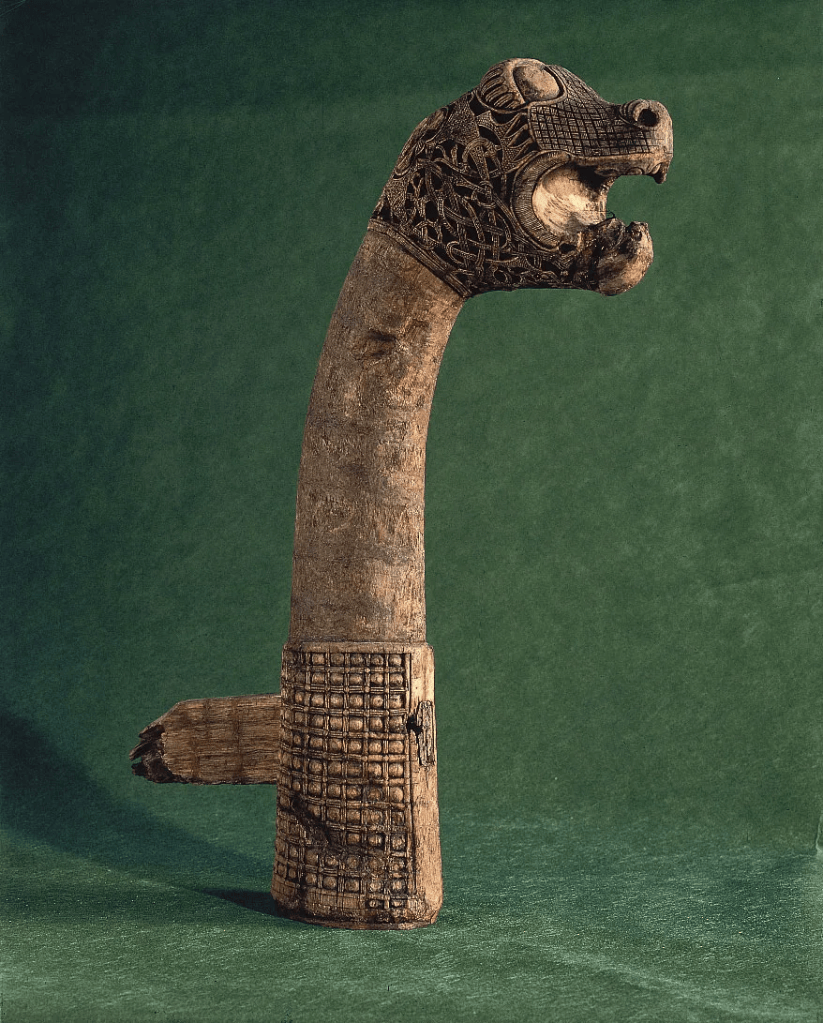
First, it projected status and power. Elaborate carving required skilled labor and wealth. Not every fishing boat or merchant vessel carried a monumental beast head. Later literary sources associate the greatest dragon ships with kings and powerful leaders.
Second, it created psychological effect. A dragon-headed warship announced danger before the first warrior stepped ashore. Whether intended to terrify human enemies, supernatural forces, or both, the symbol made the ship itself part of the threat.
Third, it may have carried protective or spiritual meaning. Medieval Icelandic tradition claims that ship captains were to remove threatening figureheads when approaching friendly land so that they would not frighten the land spirits. The account was written after the Viking Age and should not be treated as direct contemporary law, but it suggests that later Scandinavians remembered prow heads as more than decoration.
Finally, the dragon was ideally suited to the sea. The Norse dragon was often long, flexible, poisonous, and serpentine. A narrow hull riding over waves already resembled a living ormr. The dragon was not merely placed upon the ship; the entire ship became the dragon.
What Has Archaeology Actually Found?
This is where romantic imagery must give way to evidence. Wood decays, and removable figureheads are especially unlikely to survive. We do not possess a fleet of intact Viking warships with their dragon heads still mounted. What survives is fragmentary—but compelling.
The Ladby ship
The early tenth-century Ladby ship burial in Denmark contained a row of iron spirals at the bow and a spiked iron band at the stern. The wood itself had disappeared, but excavators interpreted the metalwork as the surviving decoration of an animal’s mane and tail—probably a dragon. The Viking Ship Museum’s account of Ladby describes the bow and stern ornaments as the traces of a dragon head and tail.
The Oseberg carving tradition
The Oseberg ship burial, dated to 834, preserved extraordinary carved wood. Its bow and stern terminate in elegant spirals covered with gripping and interlaced animals. The burial also contained five carved animal-head posts whose exact purpose remains uncertain. Calling each one a “dragon head” goes beyond what archaeology can prove, but they demonstrate that elite Viking-Age craftspeople created elaborate open-jawed supernatural beasts in wood.
The Birka dragon-head pin
At Birka in Sweden, archaeologists discovered a small dragon-head dress pin closely resembling a mold found more than a century earlier. The object is important not because it proves what every ship carried, but because it shows a recognizable dragon-head form reproduced in Viking-Age metalwork.
The Sigurðr stones
Several eleventh-century carvings in Sweden depict episodes from the story of Sigurðr and Fáfnir. The Ramsund carving, generally dated around 1030, shows Sigurðr killing the serpent from below, roasting its heart, and gaining knowledge after tasting its blood. Fáfnir’s body forms the long runic band around the scene. These “Sigurðr stones” are crucial because they place dragon-slayer imagery in Scandinavia before the surviving thirteenth-century prose sagas.
Thor’s fishing stones
The Altuna runestone in Sweden and the Hørdum stone in Denmark are among the objects interpreted as showing Thor’s encounter with Jörmungandr. Details differ, but the essential image—a figure in a boat pulling against a monstrous serpent—demonstrates that the story circulated visually as well as orally.
Jewelry and interlaced animal art
Viking-Age brooches, mounts, pins, and carved objects are crowded with elongated beasts that twist through their own bodies. Some are identifiable birds or mammals; some are snakes; others resist a precise species. A Viking-period Urnes-style brooch in the British Museum, for example, shows a profiled animal caught in interlace. Another disc brooch entwines its main animal with a serpent.
Not every ribbon-shaped animal is a dragon. That caution is important. Yet the repeated visual language of jaws, coils, gripping limbs, interlaced bodies, and serpents reveals a culture fascinated by creatures that crossed natural categories.
The archaeological record does not give us one standardized “Viking dragon.” It gives us something more interesting: a family of serpents, beasts, and hybrid monsters inhabiting ships, stones, jewelry, weapons, and stories.
Dragons Beyond the North
The word dragon now gathers many very different beings beneath one set of wings. They share traits, but they do not all descend from a single original creature.
| Tradition | Typical form | Common role or meaning |
|---|---|---|
| Norse/Germanic wyrm | Often an enormous snake or lindworm; wings and limbs are inconsistent | Hoard guardian, poisoner, boundary creature, embodiment of greed or chaos |
| Later Western European dragon | Usually four legs, two wings, horns, claws, and fiery breath | Enemy of saint or knight; threat to kingdom, faith, or social order |
| Wyvern | Two hind legs and wings, often with a barbed tail | Heraldic and martial monster; a later taxonomic distinction more than a universal folk category |
| Greek drakōn | Great serpent, often guarding a sacred place or treasure | Guardian and adversary; the word originally emphasized a huge serpent rather than the modern fantasy form |
| Slavic zmei/zmey | Often winged and multiheaded; sometimes humanoid or shape-changing | Can be destructive, protective, lustful, or associated with storm and fire |
| Chinese lóng | Long, serpentine, usually wingless, with features of several animals | Rain, rivers, imperial authority, fertility, balance, and auspicious power |
| Japanese ryū/tatsu | Serpentine water deity influenced by Chinese dragon traditions | Sea, rainfall, sacred power, guardianship, and transformation |
| Near Eastern dragon/chaos serpent | Serpentine or composite monster, sometimes marine | Primordial chaos defeated or restrained in the establishment of cosmic order |
| Feathered serpent traditions of Mesoamerica | Serpent joined with feathers or avian attributes | Wind, rulership, knowledge, fertility, creation, and sacred authority |
These similarities do not prove that every culture remembered the same biological animal. Human beings everywhere encountered snakes, crocodilians, large lizards, whales, predatory birds, storms, floods, and strange bones emerging from the earth. The dragon is powerful precisely because it can combine them all.
St. George—and the Saint You May Be Thinking Of
The most famous Christian dragon-slayer is St. George, but the dragon episode is not part of the earliest evidence for the historical saint.
George was remembered as a Christian soldier and martyr, probably killed during the persecutions of Diocletian in the early fourth century. The familiar story—in which a dragon terrorizes a city, consumes sacrifices, and is confronted when a princess is selected—appears much later. The earliest surviving versions associating George with the dragon emerge around the eleventh century, and the story became enormously popular in Western Europe through the thirteenth-century Golden Legend.
In that version, George wounds the dragon with his lance, has the princess bind it with her girdle, leads it into the city, and kills it after the people agree to accept baptism. It is a conversion story as much as a monster story: the Christian warrior defeats the old terror and restores an ordered world.
There is no well-established tradition in which St. Peter personally fights a dragon. The likely second dragon-slayer is St. Theodore Tiro, another Christian soldier saint. Theodore was associated with dragon-slaying imagery before George, and scholars generally believe the motif migrated from Theodore’s legend to George’s during the medieval period.
There is, however, a legend involving St. Sylvester and St. Peter. In it, a dragon lives beneath Rome and kills with its poisonous breath. Peter appears to Pope Sylvester in a vision and instructs him to descend to the beast, bind it, and seal its mouth. Sylvester confronts the monster; Peter supplies the heavenly intelligence, but he is not the warrior who fights it.
Did George, Theodore, or Sylvester encounter an actual unknown animal? History cannot prove an absolute negative, but the surviving evidence gives us no contemporary eyewitness account and no physical remains. The stories appear centuries after the supposed lives of the saints and reuse far older patterns: the hero and the serpent, the threatened maiden, the monster at the water, and order overcoming chaos.
The legends may preserve distorted memories of real dangers. They may allegorize persecutors, paganism, disease, flood, or spiritual evil. They may also have absorbed stories inspired by crocodiles, giant snakes, fossil bones, or travelers’ descriptions of animals seen far from Europe. What we cannot honestly do is treat them as zoological reports.
Did Human Beings Ever Encounter Living Dinosaurs?
Here I must separate what I find compelling to imagine from what the present evidence can support.
Sitting beneath T. rex and Quetzalcoatlus, it is difficult not to wonder whether some remnant population could have survived—perhaps in a remote forest, swamp, island, or deep body of water—long enough to enter human memory. It is an idea with enormous imaginative force. Nature has surprised us before, and “living fossils” such as the coelacanth remind us that an animal can evade scientific notice for a very long time.
My own instinct is to leave a small door open. I cannot entirely dismiss the possibility that some dragon legends began with encounters with rare, now-extinct animals. An unknown giant reptile would not have needed to survive everywhere or until modern times. It would only need to survive somewhere long enough for one terrified witness to return home with a story.
But that belief should not be confused with established paleontology. The current fossil record indicates that all non-avian dinosaurs disappeared about 66 million years ago; birds are the surviving dinosaur lineage. The American Museum of Natural History states the scientific consensus plainly, and no credible physical evidence places a non-avian dinosaur in the age of human beings.
There are other explanations that require less of a leap.
Ancient people encountered large fossil bones without possessing our concept of geological deep time. A gigantic skull or vertebra emerging from a hillside demanded an explanation, and dragon lore supplied one. Researchers have long explored the possibility that fossils helped shape stories of dragons, griffins, giants, and sea monsters. The connection is plausible in some places, though difficult to prove for every tradition. The Natural History Museum in London even describes marine-reptile fossils that inspired tales of “sea dragons.”
People also encountered real animals at the limits of reliable description. A crocodile described by a traveler, copied by a monk, illustrated by someone who had never seen one, and retold over three generations could become something very different. Add whale bones, venomous snakes, monitor lizards, great fish, storms, and the human fear of predators, and the dragon can emerge without a surviving dinosaur.
Perhaps the most honest answer is that dragons arose where observation met imagination. Real teeth, bones, snakes, oceans, and predators supplied the raw material. Story gave those materials wings.
Why the Vikings Needed Dragons
The Viking-Age world was dangerous, but it was not small. The Norse lived between forest and ocean, farm and wilderness, law and feud, hearth fire and winter darkness. Their ships carried them across waters whose depths they could not measure to lands they knew first only through rumor.
The dragon belonged wherever certainty ended.
It encircled the human world as Jörmungandr. It waited beneath the earth as Fáfnir. It gnawed at creation as Níðhöggr. It curled around memorial stones and transformed the prow of a warship into a living threat. It represented wealth that consumed its owner, chaos held barely at bay, poison beneath the water, and knowledge purchased at mortal risk.
That may be why the dragon became so prevalent in a land with comparatively few snakes. Myth is not a census of local wildlife. It is a map of human fear.
When I looked across that museum hall at animals no human being was ever supposed to have seen alive, I felt some small part of what our ancestors must have felt when they unearthed an enormous bone or watched an unfamiliar shape move through dark water. They did not possess our taxonomy or our geological calendar. They possessed a story.
And in the North, that story had scales.
Selected Sources and Further Reading
- American Museum of Natural History, “Dinosaur Facts”.
- British Museum, Viking-period Urnes-style openwork brooch.
- British Museum, disc brooch with interlaced animal and serpent.
- Cleasby and Vigfusson, An Icelandic-English Dictionary, digital Old Norse dictionary.
- Natural History Museum, London, Fossil Marine Reptiles gallery.
- Skaldic Poetry of the Scandinavian Middle Ages, narratives of Thor’s fishing expedition.
- Skansen, “Adder”.
- Viking Ship Museum, Roskilde, “Ladby”.

