By D.W. Roach
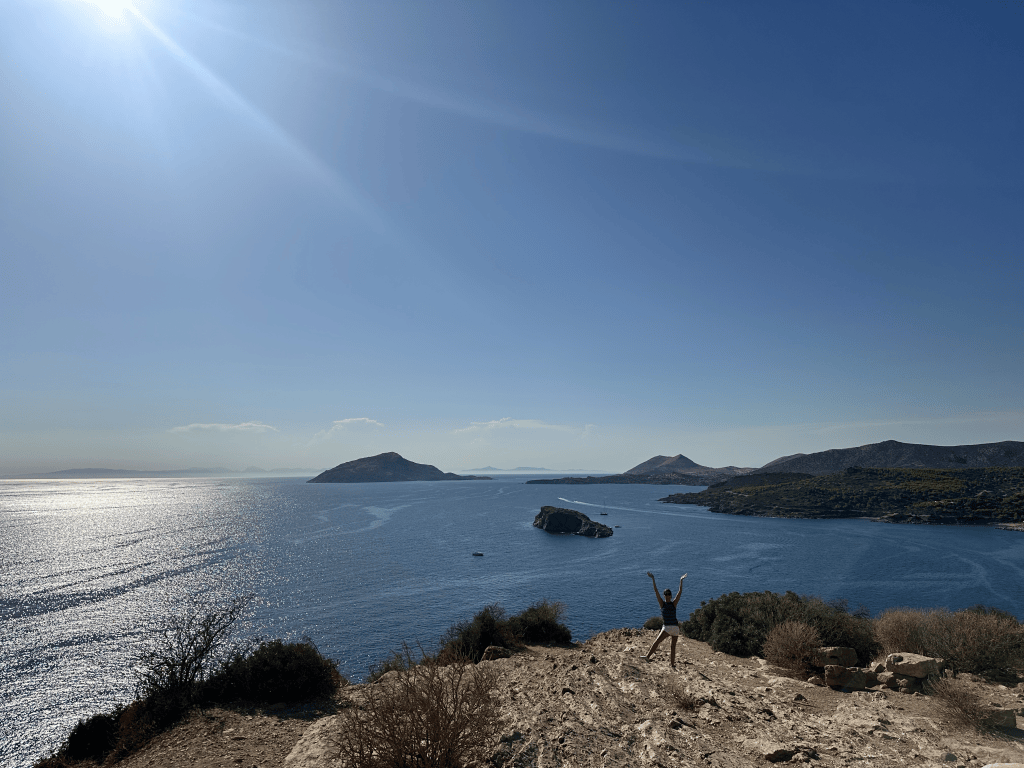
When most people imagine a trip to Greece, they picture beaches, crystal-blue water, island hopping, and whitewashed buildings. I enjoyed some of that too. I visited a few islands and even jumped from a schooner into the Saronic Gulf for a swim. But the Greece that stayed with me most was on the mainland. I traveled from Athens as far north as Meteora, moving through a landscape where one era of history seems to rise out of another.
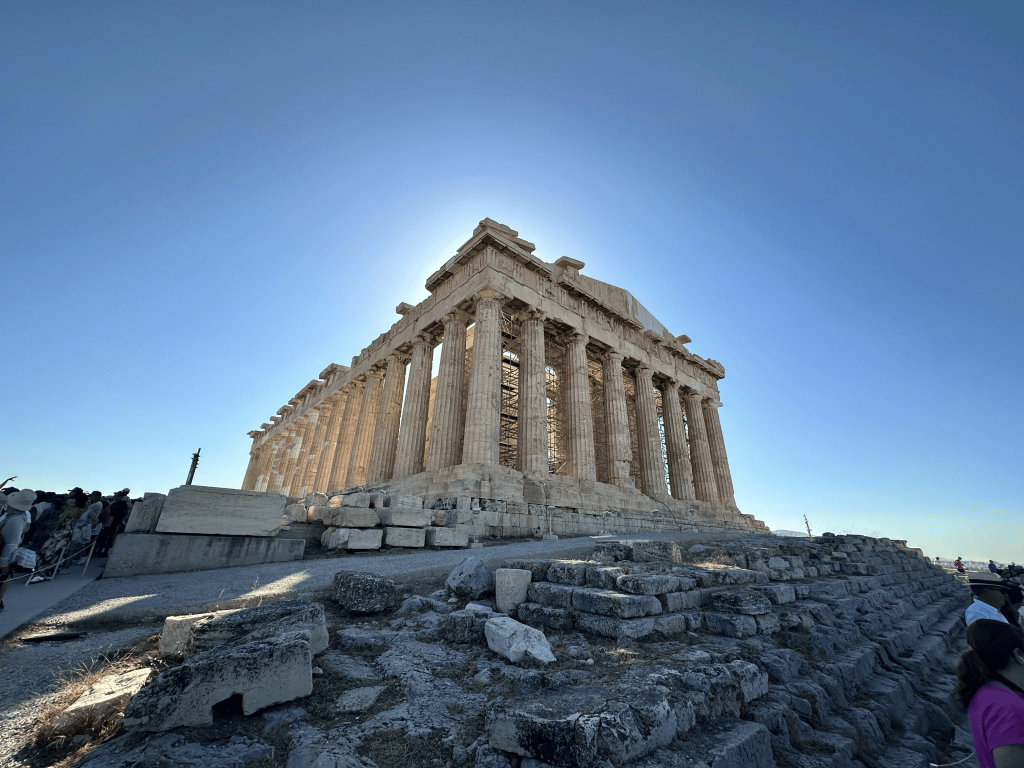
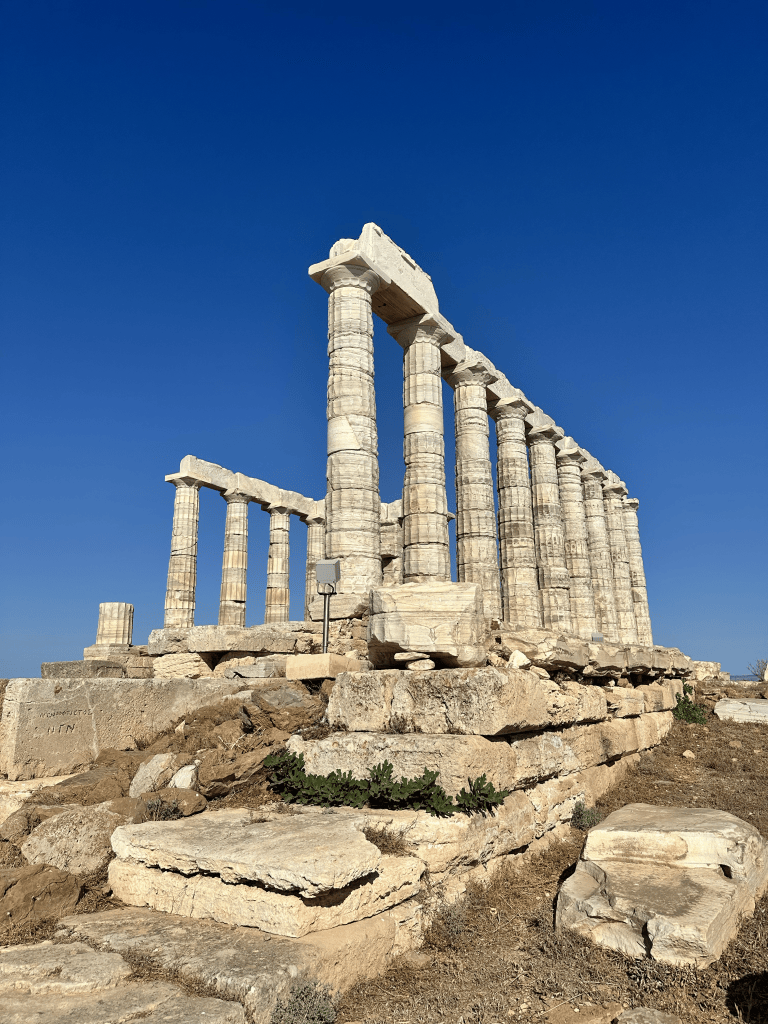
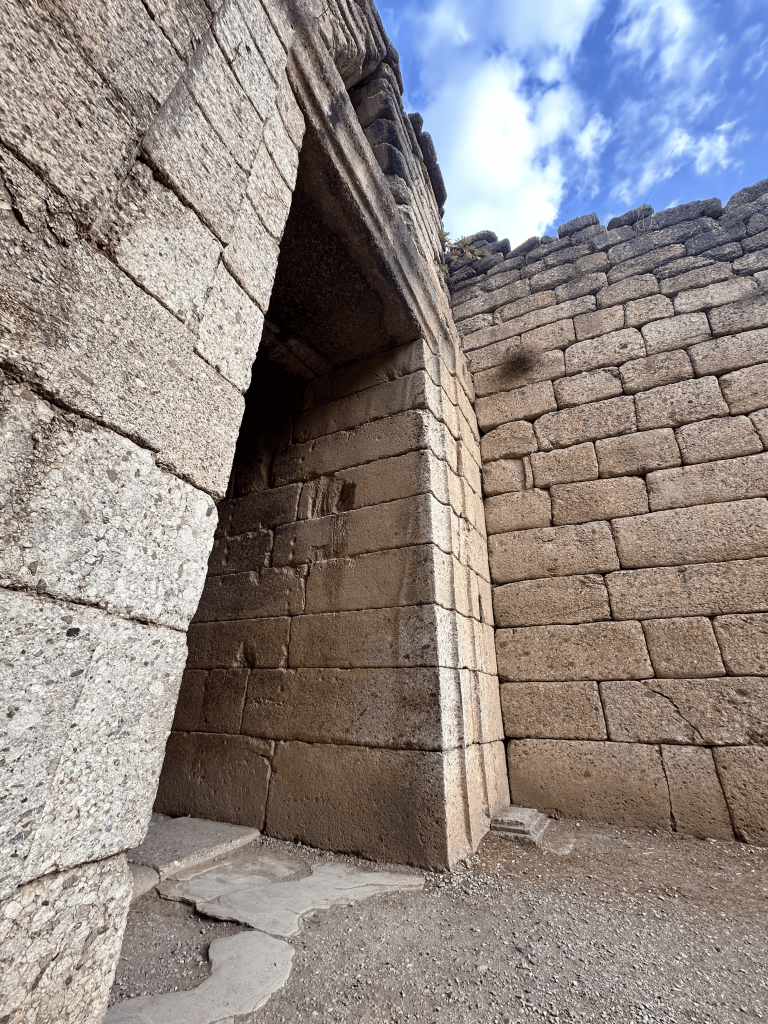
I walked the Acropolis in Athens, then ventured to Corinth, Olympia, and Delphi—where the only oracle I encountered was a cat near the stadium high on the mountainside. At Thermopylae, I visited the memorial to Leonidas and the 300 Spartans, with the site of the Hot Gates nearby. It brought me straight back to reading Steven Pressfield’s Gates of Fire. At Mycenae, I saw the remains of the palace associated with Agamemnon, the legendary king who led the Greek expedition against Troy, and the great tomb traditionally called his. That name is a later attribution, not proof of who was buried there.
Somewhere along that journey, I found myself thinking about a much later group of travelers: Scandinavians who reached the Greek world during the Viking Age. What would someone from the north have made of those enormous stone walls, the Acropolis rising above Athens, or a marble lion standing at its harbor? And how would a person raised on stories of Odin and Thor have understood a landscape marked by the older stories of Zeus, Apollo, and Athena?
There is a real history behind that question, though it needs a little care. The Greeks did not vanish after the age of Pericles, and the Vikings did not arrive in a land of temples still devoted to Zeus. By the time Norse travelers reached Greece, they had entered the medieval Roman Empire, which historians usually call the Byzantine Empire.
First, when are we talking about?
The Viking Age is conventionally dated from the late eighth century to the late eleventh century. Contact with the eastern Roman world developed over generations. Norse traders and warriors traveled through the river systems of eastern Europe toward the Black Sea. Some fought the empire; others traded with it or entered its service. By the late tenth century, Scandinavian and Rus warriors were closely associated with the emperor’s Varangian Guard. “Rus” describes a world of mixed Scandinavian and eastern European connections; it should not be treated as a synonym for every Viking.
For a story set in Greece itself, the eleventh century gives us our clearest surviving marker: runes carved into a marble lion that once stood at Piraeus, the port of Athens. The inscriptions are weathered and their exact readings remain debated, but their Scandinavian character and the lion’s Greek setting are striking. The original was taken to Venice in the seventeenth century; visitors to Greece today see a copy.
Whose Greece did they enter?
An eleventh-century visitor would have found Greek-speaking communities within a Christian Roman empire, governed from Constantinople. Its inhabitants understood themselves as Romans. They had their own courts, markets, soldiers, priests, and centuries of history between themselves and classical Athens.
The ancient landscape remained, but its meanings had changed. The gods of classical Greece were not the gods worshipped by the empire’s Christian inhabitants. Temples and monuments still stood in various states of use and repair; churches and monasteries belonged to the living religious world. At Hosios Loukas in central Greece, for example, surviving Byzantine architecture and mosaics offer a glimpse of the artistic culture of this period. It is a useful reminder that Viking-age Greece was neither an abandoned classical ruin nor a stage set for Norse adventures.
That also means the word Viking needs some room to breathe. The northerners who came east might be merchants, fighters, sailors, or men seeking wages and status abroad. Varangian is often the more useful name for those serving in the eastern Roman world. Their presence in the empire does not prove that each one visited Athens, Corinth, or Olympia.
What might they have seen?
Imagine a traveler arriving at Piraeus after years of rivers, portages, and open water. The air is warmer than home. Greek fills the streets. Stone buildings, ships, churches, and older monuments share the same landscape. A marble lion stands near the harbor. A northerner can recognize it as an impressive object without knowing who first carved it or what every local person believes it represents.
That scene is an informed reconstruction, not an eyewitness account. We cannot recover a particular Varangian’s thoughts on the Acropolis or put words in his mouth. I wonder whether a Norse visitor would have recognized familiar ideas in tales of Greek gods and heroes, or seen only the remnants of another people’s past. We cannot know what any one traveler believed, whether he even heard those ancient stories, or which mainland sites he visited. But the lion lets us ask a narrower and more interesting question: why did Scandinavian travelers choose a Greek monument as a place to leave their own marks? One reading connects part of its inscription with a dead companion. Even where the wording is uncertain, the act of carving runes tells us that people from the north stood at this harbor and wanted something remembered.
A history written across several worlds
The story of Vikings in Greece stretches from Scandinavia through eastern Europe to the Mediterranean. It belongs to Greek and Byzantine history as much as it does to Norse history. The evidence is uneven: an inscribed lion, runestones back home, and accounts of warriors in imperial service tell us different things, and none gives us a complete itinerary of Greece.
That is where this series begins. I want to follow the traces that actually lead into Greece, starting with the Piraeus Lion, then explore the routes that brought northerners south and the places they could have encountered. Traveling the mainland, I found myself looking past the familiar image of Greece as a place of beaches and islands. I saw a country layered with ancient myth, medieval lives, and the present day. Somewhere among those layers is a Norse story too—and I want to see how much of it we can honestly recover.