Two Warships, Two Worlds
By D.W. Roach
Traveling south from the port of Athens toward the island of Agistri, my eyes were met by a stunning sight.
The Saronic Gulf was alive with ships. Small fishing boats worked the coastal waters. Pleasure yachts cut across the brilliant blue of the Aegean. Oil tankers lumbered in the distance, and even a modern Greek warship could be seen among the traffic.
Then I spotted something considerably less modern. At first, I wasn’t quite sure what I was looking at. Apparently, neither was everyone else.
One by one, members of the crew of the schooner carrying us toward Agistri began making their way forward. Soon, several were gathered at the bow, staring at the same strange wooden vessel I had noticed moving across the water.
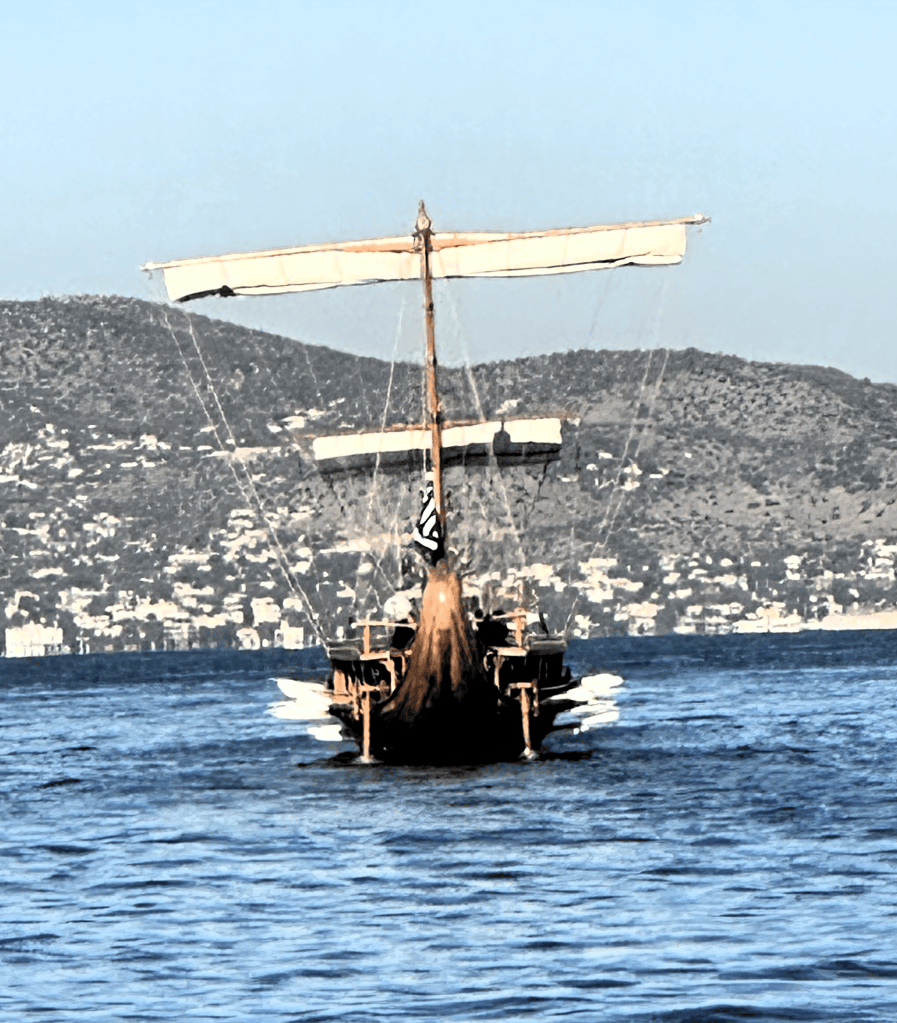
It was a trireme!
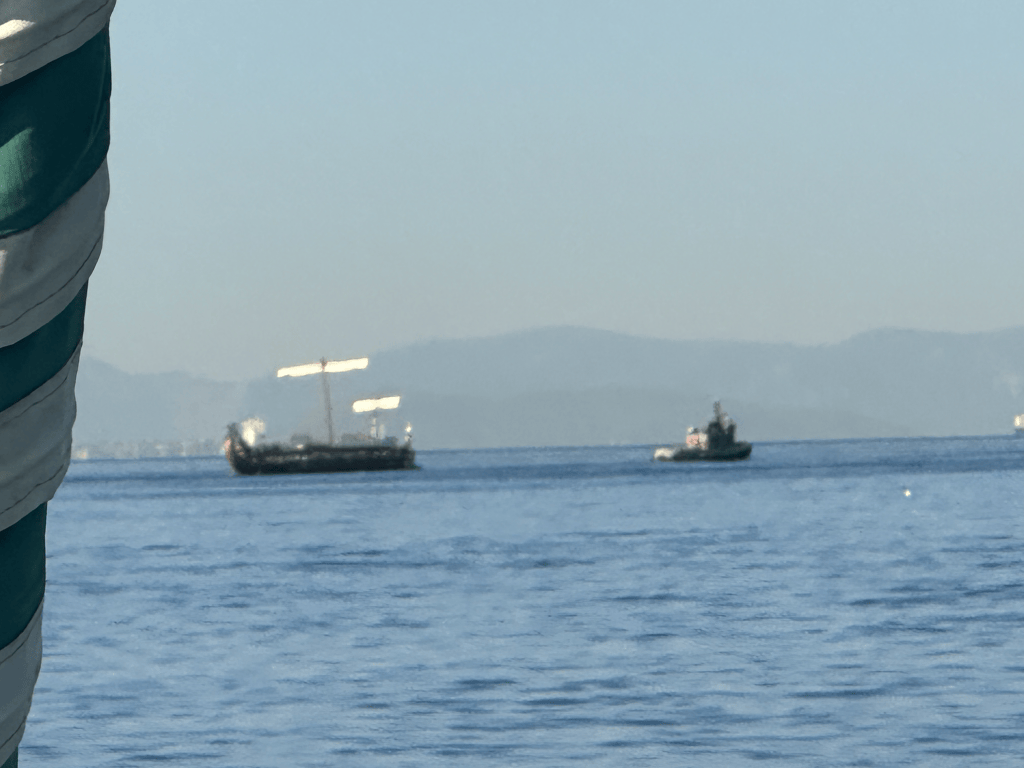
Not a museum display. Not a model. A full-sized trireme was moving through the Saronic Gulf.
As we drew closer, one of the deckhands, a Greek named Stellios, explained what we were seeing. The vessel belonged to the Hellenic Navy, and looking across its upper deck I could indeed see uniformed sailors aboard. The ship was being towed toward Salamis.
I had unknowingly stumbled across the Olympias, a full-scale reconstruction of the classical Athenian trireme maintained by the Hellenic Navy. She was headed toward the waters where, nearly 2,500 years ago, ships very much like her helped decide the fate of Greece.
And watching her pass, I immediately thought of another wooden warship.
The Viking longship.
Two vessels separated by more than a millennium.
Two civilizations separated by geography, religion, language and culture.
Yet both arrived at remarkably effective solutions to the same ancient military problem:
How do you move warriors across the sea quickly enough to defeat your enemy?
The answers produced by the Greeks and the Norse could hardly have looked more different. And yet, in some surprising ways, they were remarkably alike.
First, a Necessary Correction
Before putting these ships alongside one another, there is an important historical distinction to make.
Vikings did not arrive in Greece and encounter fleets of classical triremes.
The great age of the Athenian trireme belonged primarily to the fifth and fourth centuries BC. The Battle of Salamis—the engagement for which the ship I saw was traveling to commemorate—occurred in 480 BC. The Viking Age is conventionally placed roughly between AD 793 and 1066. By the time Scandinavian warriors began traveling through the lands of the Rus’ and entering Byzantine service, the classical trireme belonged to the distant past.
The Byzantines possessed their own sophisticated naval tradition. Their famous warships included the dromon, not the trireme of Themistocles. So this is not a comparison between two ships that historically fought one another. It is something more interesting.
It is a comparison between two warships created by very different societies, more than a thousand years apart, to dominate their respective maritime worlds.
The Greek Trireme
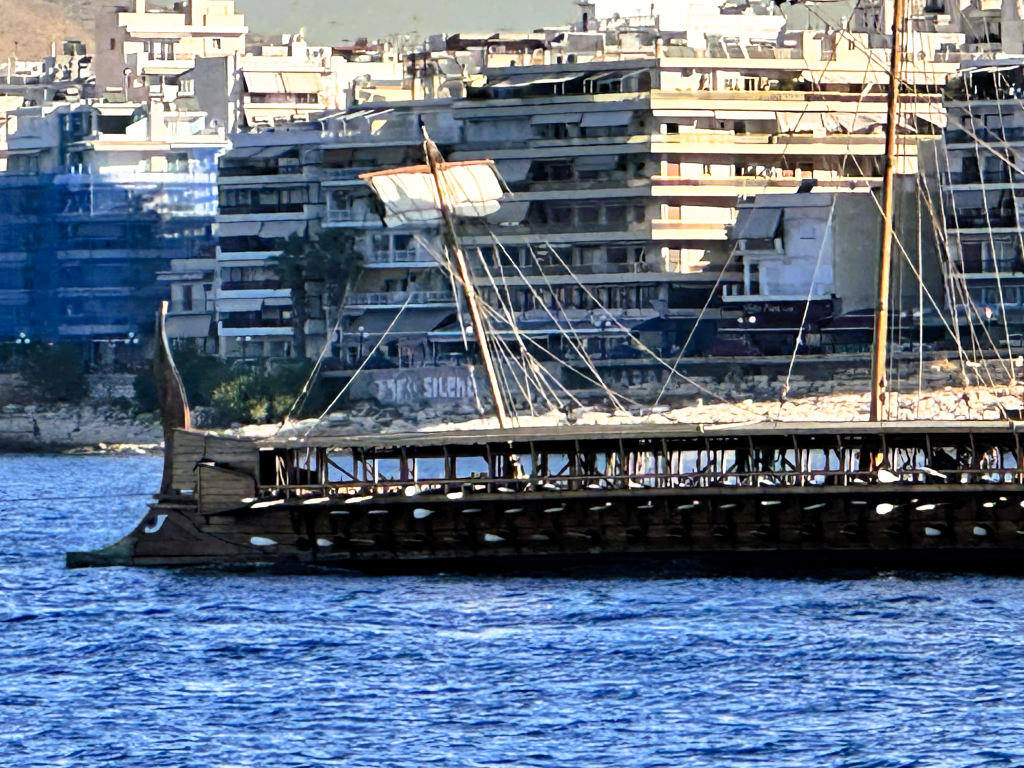
The name tells us much about the vessel. A triērēs was fundamentally an oared warship whose propulsion system arranged its rowers across three levels. The classical Athenian trireme carried approximately 170 oarsmen.
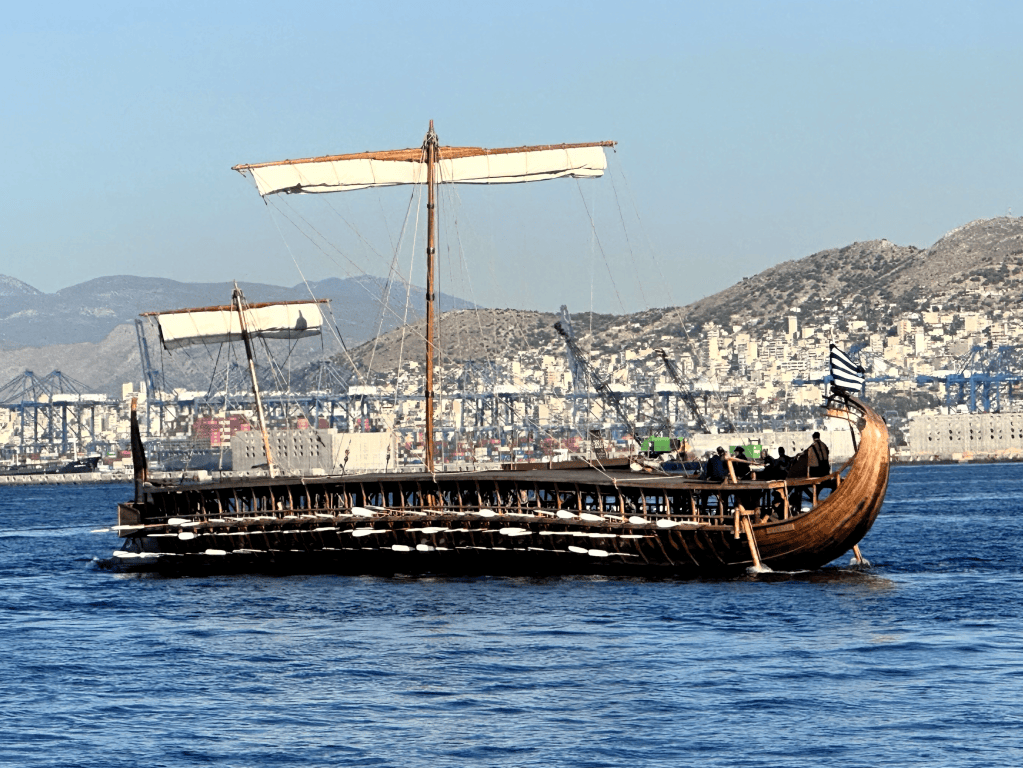
That immediately reveals the fundamental difference between the trireme and almost every Viking longship. The trireme was essentially a human-powered naval weapons system.
The modern Olympias measures approximately 37 meters long and 5.5 meters across the beam. A classical complement was around 200 men once officers, deck crew and a relatively small contingent of fighting men were included. But most of those men weren’t there to board the enemy. They were the engine. Approximately 170 rowers drove the ship through the water.
And at the bow was its primary weapon:
the ram.
The trireme was designed to fight other ships. Its captain attempted to maneuver the vessel so that its reinforced bronze ram could strike an enemy hull, damage it, disable its oars or otherwise render the opposing vessel incapable of fighting. Naval combat was therefore conducted with the entire ship functioning as a weapon.
Speed mattered.
Acceleration mattered.
Crew coordination mattered.
Turning radius mattered.
The ability of scores of rowers to respond almost instantly to commands could mean the difference between delivering the killing blow and receiving it. The trireme wasn’t merely transportation for an army.
The trireme itself was part of the weapon.
The Viking Longship
More than a thousand years later, Scandinavian shipbuilders produced a radically different kind of warship.
For comparison, consider Skuldelev 2, an actual Viking warship constructed near Dublin around AD 1042—almost exactly the period when Scandinavians were serving the Byzantine Empire.
She was approximately 29 meters long, just under four meters wide, and carried around 60 oars, with perhaps 65–70 men aboard. Like the trireme, she was extraordinarily long and narrow. Unlike the trireme, however, those men weren’t primarily propulsion.
They were warriors.
The oars got them to the battle.
The sail got them across the sea.
But ultimately, the purpose of the vessel was to deliver armed men onto an enemy shore—or alongside another vessel. And this distinction explains nearly everything else about the two ships.
170 Rowers Versus 60 Warriors
Imagine placing the Olympias beside a Viking longship such as Skuldelev 2. Their lengths would not be dramatically different.
Olympias: roughly 37 meters.
Skuldelev 2: roughly 29 meters.
Some Viking longships were even larger. Roskilde 6, the longest Viking ship yet discovered, approached 36 meters and probably carried 78 oarsmen.
From shore, therefore, an exceptionally large Viking longship and an Athenian trireme might have appeared surprisingly comparable in length. Internally, however, they represented completely different philosophies.
A trireme required roughly 170 rowers.
Skuldelev 2 required 60 oarsmen.
And the Viking rower could put down his oar, grab his shield, axe or spear and become infantry. The Athenian trireme depended upon a relatively small contingent of dedicated fighting men carried above its enormous rowing crew. One ship concentrated manpower into propulsion. The other concentrated manpower into combat power.
Sail Versus Muscle
Perhaps the greatest difference between the two vessels was how they traveled long distances. Both possessed sails. But the Viking longship was fundamentally designed to exploit wind power whenever possible. Skuldelev 2 carried a single enormous square sail estimated at approximately 112 square meters. Once underway and given favorable winds, dozens of Viking warriors didn’t need to spend their entire voyage pulling oars.
They could sail.
The oars remained enormously important. They allowed Vikings to maneuver in harbors, move without wind, approach beaches and conduct tactical movement. But the sail transformed the longship into an extraordinary strategic transportation system.
Experimental reconstructions demonstrate just how capable it was. The reconstructed Skuldelev 2—Sea Stallion from Glendalough—has an estimated average sailing speed of roughly 6–8 knots, with substantially greater speeds possible under ideal conditions. Under oars, its average was closer to 2.5 knots.
The longship’s greatest advantage wasn’t necessarily maximum speed.
It was range and flexibility.
A Viking ship could cross open seas, enter rivers, move under sail, switch to oars, navigate shallow coastal waters and then put its warriors directly onto a beach. That combination was devastating.
The Trireme Was a Missile
The longship was transportation.
The trireme was ammunition.
That may be the simplest way to understand their different philosophies. A Viking commander wanted his ship to arrive with its warriors ready to fight. An Athenian commander wanted his ship to hit another ship. The trireme’s bronze ram turned momentum into destructive force.
That demanded exceptional acceleration and maneuverability. The rowers were therefore not merely laborers moving the vessel from one location to another. They formed an integral part of the ship’s combat system. Imagine 170 men responding to commands while arranged in three banks, maintaining rhythm while their officers maneuvered through a crowded naval battle.
That required extraordinary training. At Salamis, that mattered enormously.
Salamis: Where Geography Became a Weapon
In 480 BC, the Persian king Xerxes had brought an enormous invasion into Greece. Athens had been evacuated and burned. The Persian fleet considerably outnumbered the Greek force. Themistocles understood that fighting that fleet in open water surrendered one of the Greeks’ greatest advantages. So the decisive engagement occurred in the restricted waters around Salamis.
There the enormous Persian fleet couldn’t exploit its numbers effectively. Ships became crowded. Maneuver became difficult. Coordination deteriorated. The Greeks, operating in familiar waters with disciplined crews, attacked. The result was one of history’s most consequential naval victories.
The Persian fleet suffered heavily, and Xerxes’ ability to sustain his invasion was badly compromised. That water was precisely where the Olympias was headed when I saw her.
Salaminia
Stellios told me that the ship was traveling to Salamis for commemorations of the battle.
He was right.
Every September, the island hosts Salaminia, commemorating the Battle of Salamis. The celebration is far more extensive than I initially realized. Events include historical and theatrical presentations, exhibitions, concerts, athletic competitions and traditional dancing. Ceremonies and wreath laying honor the Greek dead. And eventually the attention returns to the water.
The modern Olympias participates in the commemorations, bringing the physical form of an ancient Athenian warship back into the waters where its ancestors fought. For Salaminia 2026, the celebrations stretched across much of September, culminating in a major reenactment on September 20 at Salaminomachon Coast. The Olympias was present as thousands gathered for a presentation combining historical narration, music, drones and fireworks.
The ship I had accidentally encountered wasn’t simply out for a cruise.
She was returning to Salamis.
The Viking Advantage: Go Almost Anywhere
If the trireme’s extraordinary characteristic was tactical performance, the longship’s was strategic mobility. A Viking longship had an astonishingly shallow draft. A smaller warship such as Skuldelev 5 drew only about 0.6 meters of water. Even the much larger Skuldelev 2 drew approximately one meter.
That meant Vikings weren’t restricted to major ports. They could sail along coastlines. Enter rivers. Move deep inland. Approach beaches. And in suitable circumstances, simply run the vessel onto shore. There was no requirement to capture a sophisticated harbor before unloading an army. The beach could become the harbor.
This helps explain the terrifying operational tempo of Viking raids. A monastery or settlement might believe itself protected because no major port existed nearby. The Vikings didn’t necessarily need one. The longship itself solved the logistical problem.
The Greek Advantage: Kill the Other Ship
The trireme solved a different problem.
Athens wasn’t primarily trying to land sixty warriors unexpectedly beside an English monastery. It needed to defeat enemy fleets. Consequently, the trireme sacrificed many things that would have been valuable aboard a Viking vessel. Space was dominated by rowers. Long-duration accommodation was poor. Large crews consumed enormous amounts of water and food. Sustaining approximately 200 men aboard a relatively narrow wooden vessel for extended periods presented obvious logistical problems.
But that wasn’t what the trireme was designed to do.
It operated within a Mediterranean naval system of coastal bases, harbors and supporting infrastructure. Its purpose was tactical. Find the enemy fleet. Maneuver. Accelerate. Strike. Withdraw. Strike again. It was less an ocean-going home than an extraordinarily sophisticated fighting machine.
The Longship Was a Marine’s Ship
There is something about the Viking design that anyone familiar with amphibious warfare can appreciate. The ship wasn’t the objective.
The shore was.
The longship existed to put fighting men where the enemy didn’t want them. The Viking warrior could row. He could handle sail. He could maintain the ship. And when the bow touched the beach, he became infantry. There was remarkably little separation between sailor and warrior.
The ship therefore functioned as transportation, landing craft, troop carrier and—in the right circumstances—warship. It was not optimized for any single one of those missions to the degree that the trireme was optimized for naval battle. But it could do all of them. And that versatility allowed Scandinavian forces to operate from Newfoundland to Russia, from England to the Mediterranean.
Eventually, some of those Scandinavians reached the Byzantine world itself. They called Constantinople Miklagarðr—the Great City. Some entered imperial service. Others left their runes behind.
And a few traveled into Greece.
What If They Fought?
It is irresistible to ask. A Viking longship and an Athenian trireme meet in open water.
Who wins?
Under conditions favoring each ship’s intended role, I would give the advantage to the trireme in a dedicated naval engagement.
That’s what it was built to do. The trireme carried vastly more rowing power and possessed a purpose-built ram. Its crew trained to maneuver the entire vessel as a weapon. If its captain could strike the Viking vessel cleanly amidships, the fight might be decided very quickly.
But if the Viking ship survived the approach and managed to come alongside? Now the equation changes. The Viking crew consisted largely of armed fighting men. The contest stops being naval maneuver and becomes boarding combat. That is exactly the engagement the Vikings would want.
So the objectives would be completely different.
The Greek wants to ram.
The Viking wants to board.
And that reveals the genius of both vessels. Neither was universally superior. Each was extraordinarily well adapted to the way its civilization fought.
Two Answers to the Same Question
Standing aboard that schooner in the Saronic Gulf, I had no idea that the wooden vessel passing us would send me down this particular historical rabbit hole. I simply knew that I was seeing something extraordinary. A ship from another age moving through waters that had witnessed naval warfare for thousands of years. The trireme and the longship never faced one another.
By the time Scandinavian warriors reached Greece, the age of Themistocles and his triremes had been gone for more than a millennium. The Vikings who entered Byzantine service encountered another Roman Empire and another generation of warships. But comparing them reveals something fascinating about warfare.
Technology doesn’t develop in isolation. It develops around mission. The Athenians needed to control the sea. So they built a ship that became a weapon. The Vikings needed to cross the sea, penetrate rivers and place warriors ashore. So they built a ship that became a delivery system.
One carried approximately 170 men whose muscles powered a naval weapon. The other allowed roughly sixty warriors to cross hundreds of miles of ocean and then step ashore ready to fight. And both worked extraordinarily well.
Perhaps that was what struck me most as the Olympias passed us. Behind her were modern yachts, tankers and warships—the products of engines, steel, electronics and thousands of years of naval development. Yet almost everyone aboard our schooner had come forward to look at the wooden ship.
For a few minutes, the modern vessels barely mattered.
Because there, moving across the same blue water where Greek sailors had fought more than two thousand years ago, was a reminder that some machines don’t need to be modern to be magnificent.