By D.W. Roach
When we think of J.R.R. Tolkien, our minds naturally travel north.
We picture mist-covered mountains, deep forests, mead halls, dragon hoards, rune-carved weapons, and doomed warriors standing against the dark. We hear echoes of Beowulf, the Norse sagas, the Finnish Kalevala, and the old languages of northern Europe.
Greece—with its marble temples, sunlit seas, and very different pantheon—can seem to belong to another imaginative world entirely.
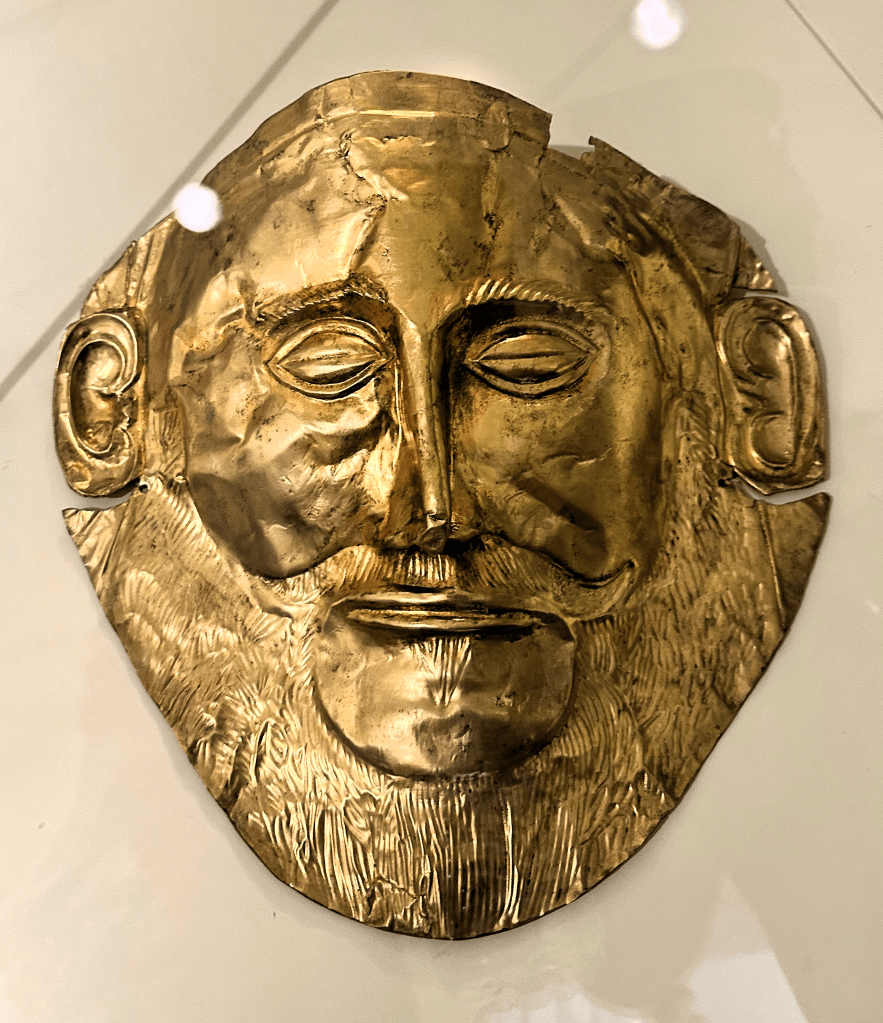
Yet Tolkien knew that world too.
During my recent journey through Greece, I found myself thinking about how later travelers interpret a land already crowded with ancient stories. At Mycenae, Delphi, Corinth, Olympia, Thermopylae, and beneath the Acropolis, the landscape never feels empty. Every mountain and ruined wall seems to carry the remains of an older age.
Tolkien never needed to stand before the Lion Gate to encounter that tradition. Greek language and literature formed part of his education from an early age, and Greek myth belonged to the great storehouse of legend from which he drew as a scholar and storyteller.
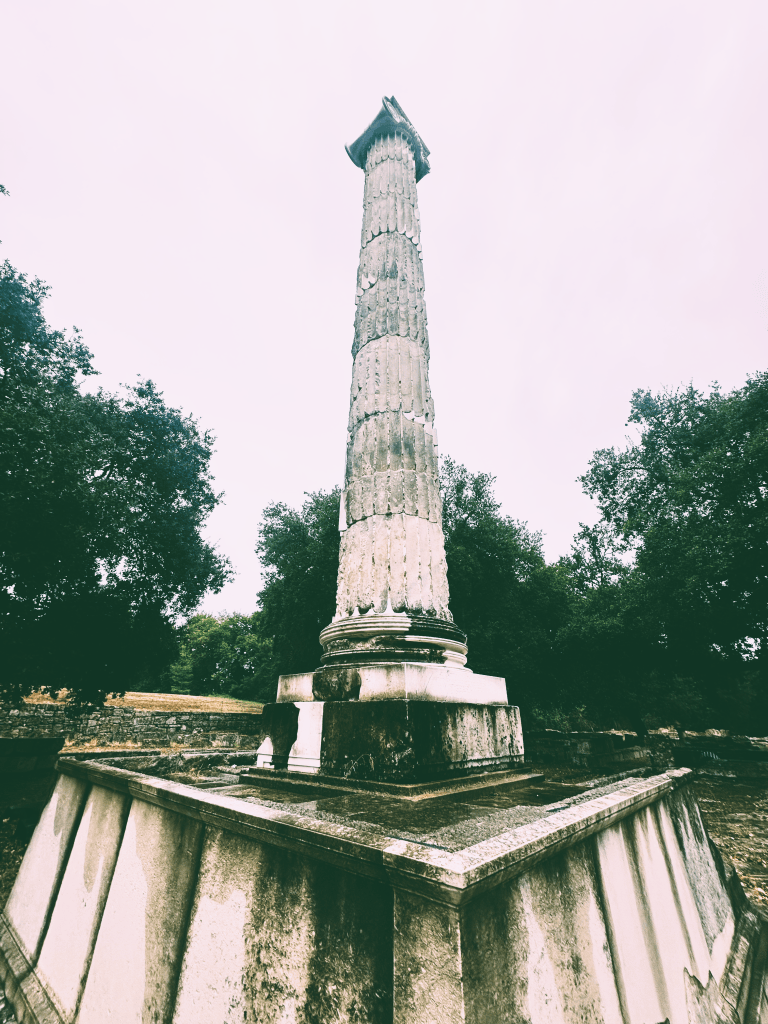
The difficult question is not whether Tolkien knew the Greek classics. He certainly did. The difficult question is how far we can trace their influence upon Middle-earth. And the honest answer requires us to separate what Tolkien documented from what readers merely recognize as a resemblance.
Tolkien the Student of Greek
Tolkien described his own education plainly.
Writing to the poet W.H. Auden in 1955, he recalled that at King Edward’s School he spent much of his time learning Latin and Greek. This was not a passing acquaintance with a few famous myths. In the classical education of Tolkien’s period, language stood at the center: grammar, translation, composition, and close engagement with ancient texts.
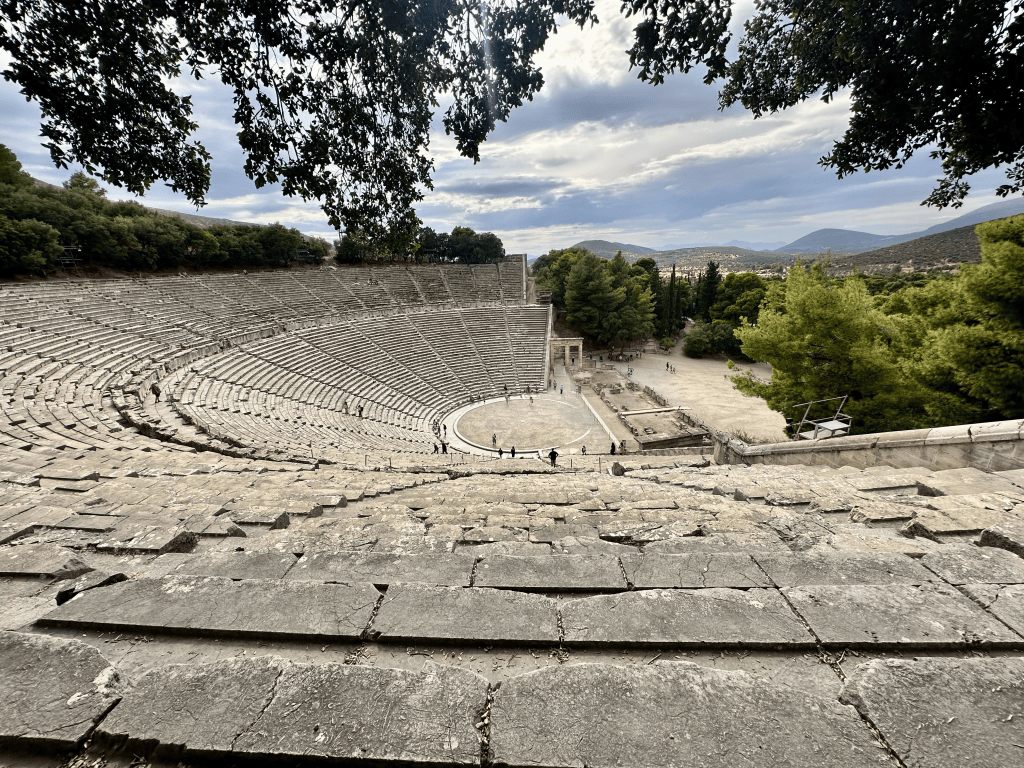
When Tolkien entered Exeter College, Oxford, in 1911, he initially read Classics. He was therefore trained not only to know stories about Achilles, Odysseus, Agamemnon, or the Olympian gods, but to approach the ancient world through its languages.
Oxford’s classical curriculum combined Greek and Latin with ancient literature, history, and philosophy. Tolkien later changed his course to English, where his extraordinary aptitude for philology found its natural home, but Greek remained part of the foundation beneath the scholar he became.
That distinction matters.
Tolkien did not encounter mythology as a modern catalogue of gods, monsters, and heroic adventures. He encountered ancient stories through words: their sounds, histories, forms, relationships, and changing meanings. For Tolkien, language and story were inseparable. He would later explain that the languages and names of his invented world were inseparable from the stories themselves. His mythology did not begin with a map onto which he sprinkled invented words for decoration.
Languages generated peoples. Peoples generated migrations, divisions, kingdoms and wars. And those histories generated legends.
Greek may not have shaped Tolkien’s invented languages as visibly as Finnish influenced Quenya or Welsh influenced Sindarin, but his classical education helped develop the philological habit of mind that made such creation possible.
Greek Legend Was Part of Tolkien’s Mythic Inheritance
The clearest evidence comes from Tolkien himself.
In a long 1951 letter to the publisher Milton Waldman, Tolkien explained that as a young man he felt England lacked a body of native mythology comparable to the great legendary traditions he admired elsewhere. Among them he specifically identified the traditions of Greece alongside Celtic, Romance, Germanic, Scandinavian, and Finnish mythology.
That small acknowledgement establishes something important. Greek legend belonged to the mythological landscape within which Tolkien imagined his own work. It does not, however, mean that Middle-earth is secretly Greek mythology dressed in northern clothing.
In that same discussion Tolkien made clear that the mythology he wanted to create should possess the atmosphere and soil of northwestern Europe. He consciously distinguished the imaginative world he desired from the Mediterranean and Aegean world. That is the balance worth preserving. Tolkien’s imagination was not sealed inside Scandinavia. Nor was it an indiscriminate mixture of every mythology he had encountered.
He drew from an enormous intellectual inheritance while consciously choosing a northern character for his own mythology.
What Can Actually Be Called Greek Influence?
Several conclusions rest on firm evidence. Tolkien received substantial formal instruction in Greek and Latin. His initial university course was Classics before he moved into English language and literature. He expressly identified Greek legend among the great mythological traditions known to him. And classical study formed part of the philological education through which Tolkien learned to examine the intimate relationship between language, culture, history, and story.
We may also recognize that Tolkien worked within literary traditions that the Greeks helped transmit to later European civilization:
Epic.
Tragedy.
Heroic legend.
The long voyage.
The fall of great houses.
The tension between fate and choice.
The terrible consequences of pride.
The warrior who knows that he may be doomed and chooses to stand regardless.
The king attempting to escape the consequences of an older generation’s decisions.
The hero returning from a journey to discover that neither he nor his home is quite what it once was.
Tolkien did not need to imitate Homer, Sophocles, or Aeschylus for these traditions to inhabit the intellectual world of an Oxford philologist. But broad inheritance is different from a provable source. And this is where discussions of Tolkien and Greece can become dangerous.
Tempting Parallels—and the Limits of the Evidence
The strongest Greek-looking parallel is perhaps Númenor, Tolkien’s great island civilization destroyed beneath the sea. The resemblance to Atlantis is obvious. More importantly, Tolkien himself recognized it. He described a recurring dream of an overwhelming wave that he called his “Atlantis complex,” connected that image directly with the Downfall of Númenor, and eventually gave an echo of the dream to Faramir. The Númenórean name Atalantë, referring to the Downfallen, inevitably strengthens the association. Here we can stand on relatively firm ground.
Tolkien consciously associated the destruction of Númenor with Atlantis. What we should not do is leap from that fact to the claim that Númenor is simply Tolkien’s retelling of Plato.
It isn’t.
Tolkien embedded Númenor within his own mythology, his personal recurring dream, his Catholic conception of pride and fall, and the much wider human tradition of floods and drowned civilizations. Atlantis is a documented association. Claiming that every element of Númenor derives from Plato would be speculation. Other comparisons become even more uncertain.
Readers may hear something Homeric in Tolkien’s sea voyages, long separations, homecomings, councils, laments, battlefield speeches and doomed warriors. They may compare the pride and ruin of Fëanor or Túrin with Greek tragic heroes. They may see in the Valar a distant structural resemblance to a family of powerful divine beings associated with different aspects of the natural world. Those are fascinating comparisons.
But they remain interpretations unless Tolkien’s manuscripts, letters, or recorded comments establish the connection. Human beings across civilizations repeatedly tell stories about power, mortality, kinship, exile, vengeance, pride, sacrifice and return. Similarity does not automatically establish ancestry.
The Valar demonstrate the danger particularly well. Tolkien explicitly resisted treating them as pagan “gods” in the ordinary sense. They are created beings existing beneath the one Creator, Eru Ilúvatar. Whatever surface similarities we might notice between Valinor and Olympus, Tolkien’s cosmology operates within a fundamentally different theological order.
Greece in the Education of a Northern Mythmaker
Perhaps Greek influence upon Tolkien is best understood not as a trail of borrowed characters, but as part of his apprenticeship in myth.
Greek taught him to encounter an ancient people through their language. Greek epic demonstrated how a civilization could preserve memory through heroic song. Greek tragedy showed noble houses undone by pride, inherited wrongs, impossible choices, and the workings of doom. And Greek mythology demonstrated how completely a landscape could become saturated with story.
A mountain is no longer merely a mountain.
A spring is no longer merely water emerging from stone.
A cave, island, battlefield, or ruined city can exist simultaneously in the physical, historical, and mythological worlds.
That quality became particularly vivid to me while traveling through Greece. Delphi is not merely stone scattered across a mountainside. Mycenae is not merely a collapsed fortress. Thermopylae is not merely a narrow passage altered by centuries of sediment. Each exists physically before you while simultaneously occupying another world composed of history, memory and legend.
Middle-earth works in much the same way.
A broken sword remembers the fall of a kingdom.
A burial mound remembers the dead beneath it.
A ruined watchtower recalls the civilization that constructed it.
A road is never merely a road. It is the surviving line of older journeys.
Tolkien’s landscapes possess depth because songs, names, defeats, migrations and half-remembered ages lie beneath the feet of his characters. Is that specifically Greek?
No.
Tolkien found it throughout the legendary traditions he loved, particularly those of northern Europe. But Greece offered one of civilization’s greatest examples of a land made almost inseparable from its stories. And Tolkien had studied those stories in their own language.
When the Stones Remember
There is another quality of Tolkien’s world that I found difficult not to think about while walking through Greece.
Arda is old.
Not simply old because Tolkien supplied it with a chronology extending across thousands of years.
It feels old.
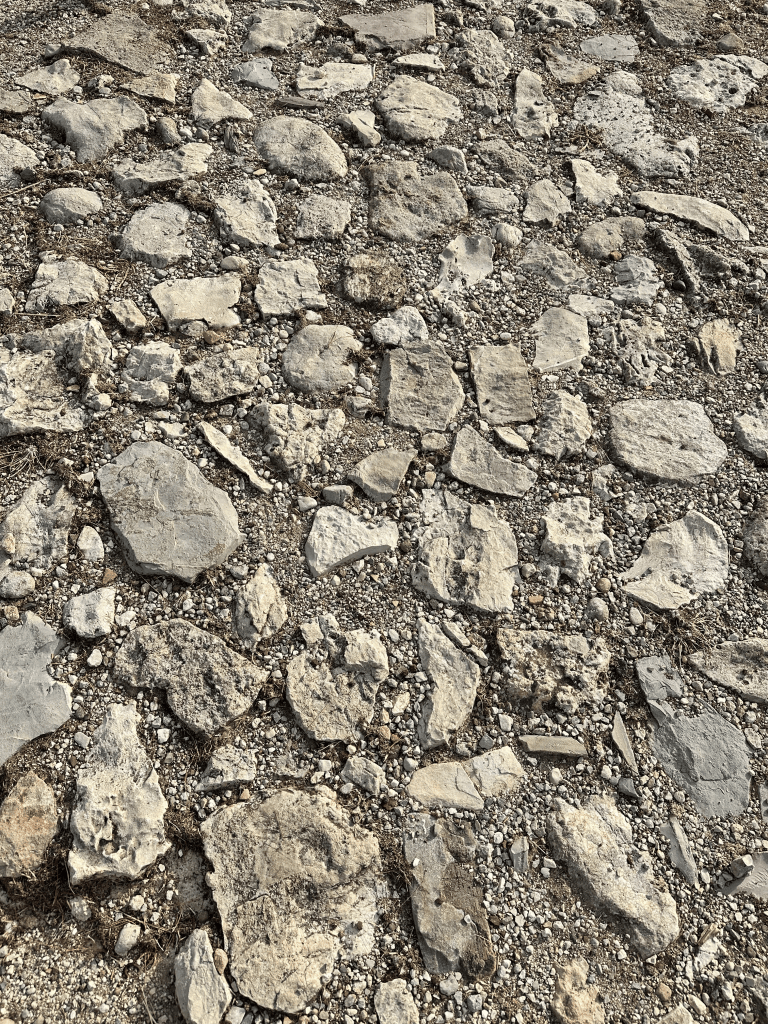
Who walked amongst these hallowed paths of old…
His characters walk through a world littered with the remnants of things that came before them: broken roads, abandoned watchtowers, ruined kingdoms, ancient swords, forgotten tombs, songs whose subjects have passed beyond living memory, and names belonging to peoples who are no longer there to answer to them.
The traveler in Middle-earth is constantly being reminded that he has arrived late. There were greater kingdoms before him. Fairer cities. Mightier craftsmen. Older songs. Deeds so great that the people who performed them have become legends to their own descendants. Even Gondor, magnificent as it appears to the hobbits encountering it, carries this melancholy.
Its greatness is real, but so too is the knowledge that it represents the surviving remnant of something greater. Arnor has vanished. Númenor lies beneath the sea. Osgiliath is broken. The old roads still cross the landscape, but the hands that built them are dust. There is something haunting about that idea. It asks a question that reaches far beyond fantasy:
What must it feel like to live among the ruins of a world that you believe was once more beautiful than your own?
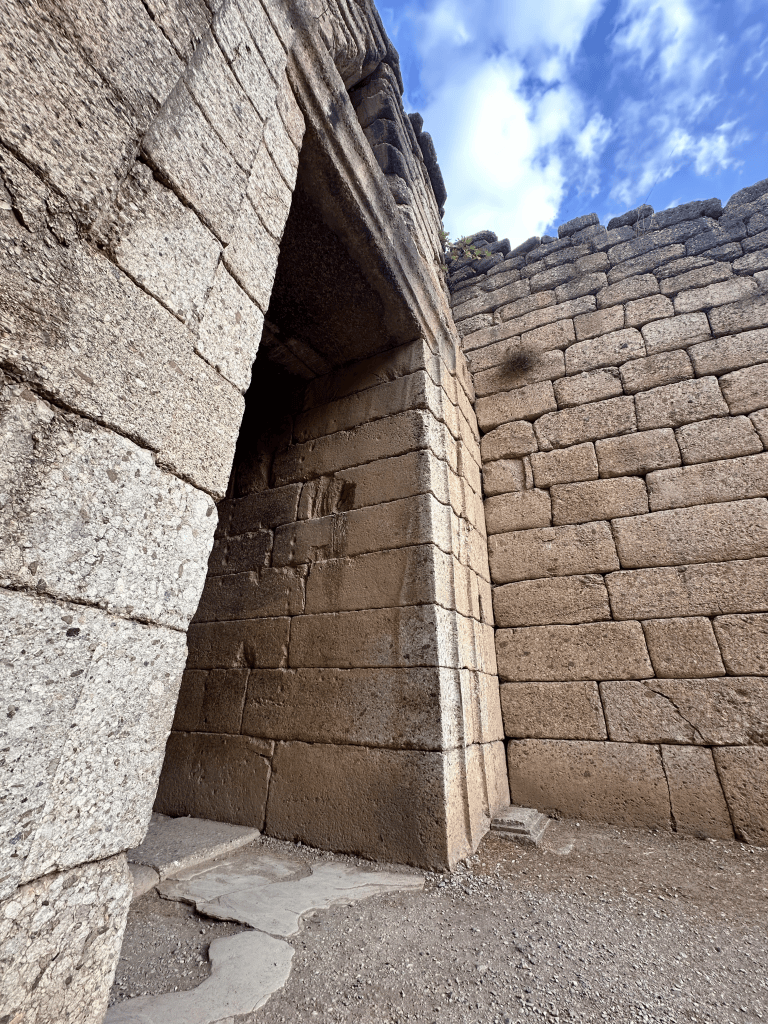
I found myself asking something remarkably similar in Greece. At Mycenae, I walked through the Lion Gate and wondered about the hands that lifted stones weighing many tons into place more than three thousand years ago. At Delphi, I stood among the remnants of temples climbing the mountainside and tried to imagine them not as ruins, but as they once were: painted, decorated, crowded with pilgrims, priests, athletes, treasuries, offerings, music, smoke, conversation and life.
And in Athens, standing beneath the Acropolis, perhaps the most difficult act of imagination was not picturing its destruction. It was picturing its completion. We encounter the Parthenon today as a ruin and still call it beautiful.
What must it have been like when it was whole?
That question followed me through Greece.
Who built these places?
How?
What did they look like when the marble was new, the columns complete and the sanctuaries alive?
What combination of wealth, faith, ambition, craftsmanship and civic pride convinces a people to build something whose beauty might outlive everyone who participated in its construction?
And inevitably another question follows.
Why did we stop?
Did We Stop Building Beautiful Things?
That question is probably unfair. Modern civilization produces wonders an ancient Greek could scarcely comprehend. Our buildings are safer. Our cities possess sanitation, electricity, climate control, elevators, communications, fire suppression, modern medicine and engineering capabilities that would appear supernatural to the people who raised the temples at Delphi.
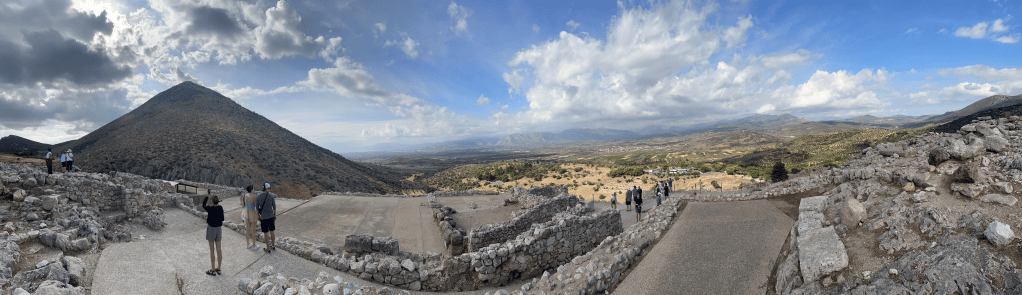
We have not become incapable of building great things. Yet walking through Athens, I sometimes wondered whether becoming better at constructing buildings had necessarily made us better at creating places. Athens itself provides an extraordinary contrast.
Neoclassical buildings still appear throughout the city, their columns, pediments, proportions and ornament deliberately reaching backward toward the civilization beneath modern Athens. And beside them one can find stark rectangular structures seemingly designed according to an entirely different philosophy: efficient, economical, repeatable and largely indifferent to whether anyone might stop a thousand years from now simply to look at them.
They reminded me, perhaps unfairly, of office cubicles writ large. Functional spaces for temporarily storing human beings. There is nothing uniquely Greek about this contrast. Nearly every modern city contains it. Nor should we romanticize antiquity.
The Greeks themselves lived among poverty, war, disease, slavery, political violence and countless ordinary buildings that disappeared precisely because they were never monuments.
History preserves masterpieces and conveniently disposes of much of the mediocrity.
Compress several thousand years into a week-long journey and we inevitably compare the greatest achievements of countless generations with whatever apartment block happens to stand across the street.
That is hardly a fair contest.
And yet…
The feeling remains.
Tolkien and the Long Defeat
I think Tolkien understood that feeling extraordinarily well. His stories repeatedly mourn things that cannot be restored exactly as they were.
Beauty fades.
Languages disappear.
Forests are cut down.
Kingdoms decline.
Songs are forgotten.
People depart.
And even victory cannot reverse every loss.
There is a temptation when reading Tolkien to interpret this merely as nostalgia—to imagine that everything ancient is good and everything new represents decline. I think that misses something important. Tolkien’s characters cannot return to the Elder Days. That world is gone.
Aragorn can restore the kingship, but he cannot raise Númenor from beneath the sea.
The War of the Ring can be won, but the Elves are still departing.
Sauron can be defeated, but Frodo cannot simply become the person he was before carrying the Ring.
The Shire itself can be restored, but not everything that happened can be undone.
Victory in Tolkien is therefore often bittersweet. The world is saved. But the world is also changing. And the great question becomes not whether the characters can recreate the world that existed before them. It is what they will do with the world that remains.
Frodo at one point wishes that the terrible events surrounding him had never happened in his lifetime. Gandalf’s answer, in essence, is one of the great ideas running through Tolkien’s work:
None of us chooses the age into which we are born. What remains within our control is what we choose to do with the time given to us.
Perhaps that is also the answer to the melancholy of ruins.
Are We Lesser Than Those Who Came Before?
Standing among the monuments of Greece, it is easy to wonder.
Perhaps we are diminished.
Perhaps something was lost.
Perhaps there really was an age when beauty mattered more.
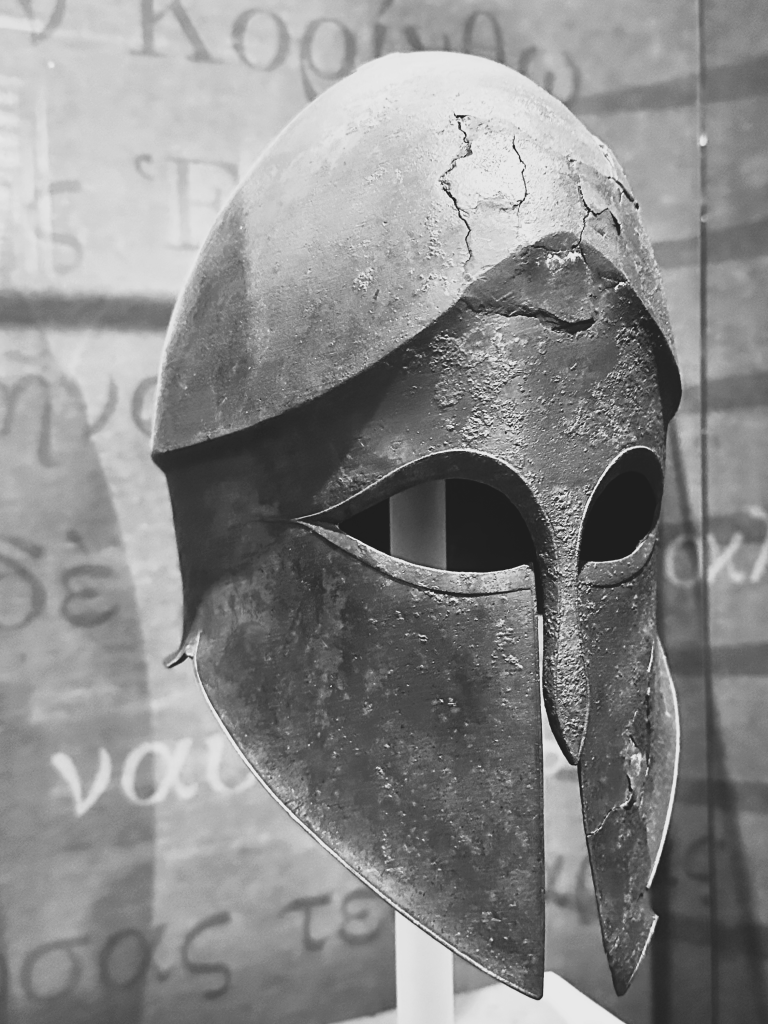
But that thought deserves resistance too. We are not the Greeks who raised the Parthenon. We are not the Númenóreans who built the great works whose remnants astonish travelers in Middle-earth. But neither should we imagine ourselves lesser simply because we can see their surviving masterpieces.
Our ancestors were human beings.
So are we.
They inherited a world they did not create. They struggled within it for a brief span. And then they disappeared. Most left almost nothing behind.
A few left stones.
A few left words.
A few left songs.
And perhaps civilization has always depended upon enough people deciding that survival alone is insufficient—that something should also be made beautiful.
That may be one of the deepest connections I felt between Tolkien and Greece.
Walking among those ruins did not ultimately make me wish that I had lived two thousand years ago. It made me wonder what we will leave behind. And perhaps that is a more useful question. We cannot rebuild the past merely by mourning it. Nor can we know whether our own age will someday appear beautiful to people looking backward across centuries. But we can still build.
We can write books.
We can carve stone.
We can plant trees beneath whose branches we will never sit.
We can make music.
We can preserve stories.
We can teach our children what came before them.
We can choose, in whatever small corner of the world has been entrusted to us, not merely to occupy space but to add something to it.
Perhaps that is why ancient ruins can make a man melancholy without making him despair. They remind us that beautiful things can disappear. But they also prove that human beings once made them. And therefore, perhaps, we can again.
The More Accurate Picture
Tolkien was not a Greek imitator. Middle-earth was never intended to reproduce the Aegean world. He deliberately sought a cooler, northwestern atmosphere, and the most visible roots of his creation remain Germanic, Norse, Finnish, Celtic and medieval Christian.
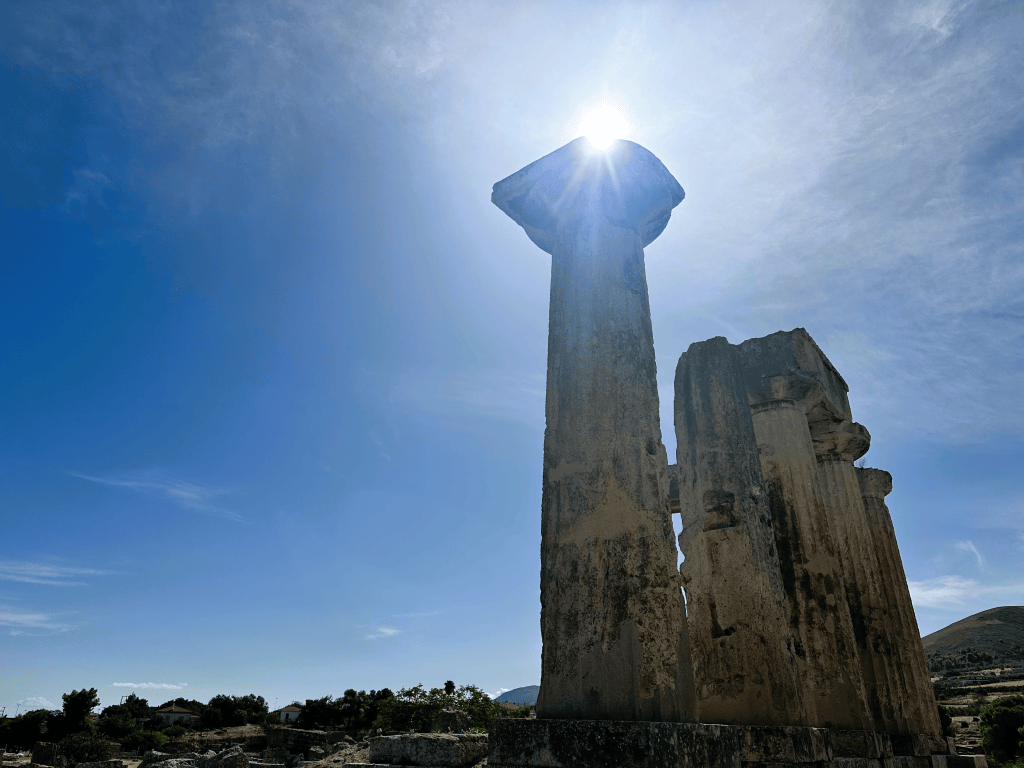
Yet it would be equally mistaken to imagine that Greek language and literature left no mark upon him. Greek formed part of his education. It formed part of his philological discipline. Greek legend stood among the great mythological traditions against which he contemplated the absence he felt in English tradition. And perhaps Greece provided something more subtle than characters or plot. It provided another example of what Tolkien understood so well:
A civilization survives partly through the stories it leaves behind.
That realization is difficult to escape while standing in Greece.
Empires collapse.
Temples fall.
Languages change.
Gods cease to be worshipped.
The people who built the monuments disappear.
And still, thousands of years later, someone walks through a ruined gateway and asks:
Who were they?
What happened here?
What did this place look like when it was whole?
Perhaps that is why Tolkien’s ruins feel so convincing. He understood that the most powerful ruins don’t merely tell us that something was destroyed. They make us mourn something we never saw. The Greek classics were not the blueprint for Middle-earth. They were part of the deep library behind the man who built it.
And that may be the more meaningful kind of influence: not a borrowed god or copied hero, but years spent learning how language preserves a people, how stories preserve a civilization—
and how myth can make the stones themselves remember.
Author’s Research Note
This article deliberately distinguishes three levels of influence when discussing Tolkien and Greece.
Documented: Tolkien studied Greek and Latin, initially read Classics at Oxford, specifically identified Greek legend among the mythological traditions familiar to him, and consciously associated the Downfall of Númenor with Atlantis.
Reasonable historical context: Classical study contributed to Tolkien’s philological education and exposed him deeply to the traditions of epic, tragedy, heroic legend and ancient mythology that permeated European literature.
Interpretive: Specific equivalences between Tolkien’s characters, peoples, gods, events and figures from Greek mythology should be treated as comparisons rather than established sources unless Tolkien’s own writings or other documentary evidence support them.
Sources and Further Reading
- J.R.R. Tolkien, letter to W.H. Auden, 7 June 1955 — Tolkien Estate. Tolkien discusses his Greek and Latin schooling, study of Classics at Oxford, linguistic development, and what he described as his “Atlantis complex.”
- J.R.R. Tolkien, letter to Milton Waldman, 1951 — Tolkien Estate. Tolkien identifies Greek among the legendary traditions familiar to him and explains the deliberately northwestern character he intended for his own mythology.
- Tolkien Estate biographical timeline, 1892–1949. Chronology covering Tolkien’s schooling, Oxford education, scholarship and development of his early legendarium.
- University of Oxford, Honour Moderations in Classics. Background on the language, literature, history and philosophy traditionally encompassed by Oxford classical study.

